Global Mobility 1.1 How to talk about your plans to move
Master your move with a professional elevator pitch. Perfect for global mobility and networking.

Master your move with a professional elevator pitch. Perfect for global mobility and networking.

Humans find it difficult to adapt to change and this is evident in how technological advances are viewed. This is nothing new because even Socrates, the architect of Western philosophy, wasn't too excited about the introduction of writing, as he felt people would become more forgetful.
It may be natural to fear change, but we have to realize that by nurturing this kind of fear, we are resisting innovations that could improve our quality of life, productivity and connectivity.

Gene-editing technology known as CRISPR is becoming more and more widely available. CRISPR is the name of a family of DNA sequences, parts of which can be used like a pair of molecular scissors capable of cutting strands of DNA. However, many in the scientific community have sounded the alarm because doing this activity outside of professional laboratories could be quite dangerous.

Will.i.am of the Black Eyed Peas has designed a high-tech face mask that looks like something out of a sci-fi movie. Called Xupermask, it has three dual-speed fans to keep you cool, and a design to keep you looking cool. The real money-grabbers are noise-canceling headphones, LED lights for nighttime, and Bluetooth capability. You can listen to music, take and make calls, and put on your own light show while wearing this thing. It doesn't come cheap, but at $299, it costs less than a set of Bose headphones, and a lot less than a mobile phone!

The year 2020 has served as a benchmark for many predictions, from business markets to technological advances to climate change. In 2015, Factor magazine published a list of ten predictions for 2020, most of which have come true.
Same-day cancer treatment: YES
Self-driving cars on the road: YES
Cannabis market legalized and booming: YES
4 billion internet users: YES (almost 4.5 billion)
Mathematicians, computer engineers and scientists in related fields should take a Hippocratic oath to protect the public from powerful new technologies under development, says Hannah Fry, an associate professor of mathematics at University College, London. The ethical pledge would commit scientists to think deeply about the possible applications of their work and compel them to pursue only those that, at the least, do no harm to society.
Recently, the ancient art of origami has begun to merge with modern engineering. Origami principles have inspired novel ways of packaging airbags, fashioning heart stents, folding solar sails designed to propel spacecraft, and even collapsible bullet-proof shields.

In 1989, physics researcher Jim Berners-Lee began writing code for what would become the World Wide Web. Thirty years on, and Berners-Lee’s invention has more than justified the lofty goals implied by its name. But with that scale has come a host of troubles.

“Ultra-lightweight space blankets have been around for decades, but the key drawback is that the material is static," said Alon Gorodetsky, UCI associate professor of chemical & biomolecular engineering. "We've made a version with changeable properties so you can regulate how much heat is trapped or released."
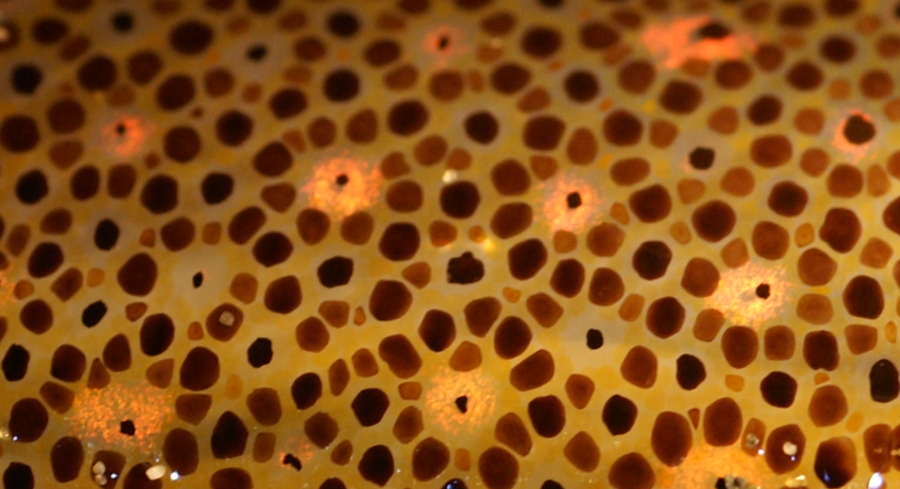
The researchers took design cues from various species of squids, octopuses and cuttlefish that use their adaptive skin to thrive in aquatic environments.

Bernice Belcher needed an artificial aortic valve replacement. Her surgeons decided to use a new 3D modeling technique.
Using CT scans that are manipulated via special software, a team of engineers creates a model fashioned from flexible materials that re-create the texture of the aorta and its surrounding structures. Then the model is loaded into a heart simulator: a box filled with pumps and bloodlike fluid.

Your next smartphone might just throw you a curve.
Picture this: You pull your phone out of your pocket and unfold it like a napkin into a tablet. You press your finger on the screen, and it unlocks. You switch to the camera app, and a spider-like array of lenses shoot simultaneously to capture one giant photo.
In 2008, research teams at Duke and Harvard surveyed 652 U.S.-born chief executives and heads of product engineering at 502 technology companies. They learned that, although a degree made a big difference in the success of an entrepreneur, the field it was in and the school that it was from were not significant. YouTube chief executive Susan Wojcicki, for instance, majored in history and literature; Slack founder Stewart Butterfield in English; Airbnb founder Brian Chesky in the fine arts.
5G, or 5th generation mobile, is the next big leap in wireless communications. 5G will radically improve the bandwidth, capacity and reliability of mobile broadband, and will push mobile speeds from 100 Mbps to upward of 10 Gbps.
But the real excitement over 5G comes with new uses that simply aren’t possible with today’s networks. Many of these involve the revolution in sensors, low-cost transmitters and cloud-based software known as the Internet of Things (IoT).
Renewable energy is set to be generating 50% of global electricity by 2050.
The New Energy Outlook (NEO) 2018 says that the continuing fall in the cost of batteries will massively increase the ability to store off-peak electricity and sell it when demand is high, which will enable renewable technologies--particularly wind and solar projects--to take an increasing share of the electricity market.
Europe’s electricity market will be 87% renewable in Europe by 2050, while India’s will be 75% renewable, China’s 62% and 55% in the U.S., the report says.

New Zealand hasn't been walking the talk on climate risk, finds a sweeping new analysis of hundreds of annual reports and statements.

A pioneering project by Highview Power will turn air into liquid for energy storage to help electricity grids cope with a growing amount of wind and solar power.

In the summer of 2019, French swimmer and anti-plastic campaigner Ben Lecomte swam through the giant floating rubbish mass known as the Great Pacific Garbage Patch.
The exact size of the Great Pacific Garbage Patch is impossible to determine, but estimates put it anywhere from 700,000 to 15,000,000 km² (or the size of Texas to the size of Russia). The patch is caused by the North Pacific gyre—a circle of currents that keep plastic, waste and other pollution trapped. According to scientists, the Patch has been growing “exponentially” in recent years.

At the MIT Technology Review’s EmTech conference held in Singapore this [year], Japanese researcher Jun Rekimoto presented a form of tech called ChameleonMask which he dubbed a “Human Uber” that “shows a remote user’s face on the other user’s face.”
How it essentially works is: ChameleonMask uses a real human as a surrogate for another remote user. The surrogate user wears a display as a mask which shows a remote user’s live face and transmits the user’s voice.




![Water droplet [Photo by José Manuel Suárez]](https://commons.wikimedia.org/wiki/File:Water_drop_001.jpg#/media/File:Water_drop_001.jpg)
