Prices, course design and negotiation
Negotiation
Non-negotiable:
- attendance policy (10 minutes or people are absent);
- minimum notice on cancellations (12 hours);
- confidentiality (We cannot tell people who our clients are in print, but we can say our clients' names. When writing, we can make oblique references to who our clients are—e.g. Big Three consulting firm—depending on who we are talking to.);
- 25-minute lessons (people are welcome to take 2 or more lessons if they want longer lessons).
Negotiable:
- lesson price (to a maximum discount of 8%, depending on volume);
- matriculation fees (to a maximum discount of 40%);
- term length and start time (from 2 months; term start should be out of phase with other clients);
- payment model (3 models: the company pays upfront—preferred, the student pays and gets reimbursed, or we give them a discount code to share with staff);
- extensions (deadlines can be adjusted according to what the company's HR wants; if teachers cancel lessons near the end of term and students miss lessons because of that, we can discount those lessons from the attendance report and extend their points' expiration date)
- number of points each student can get—from 1 to 100 per term;
- student buys materials or TEF supplies materials (affects the matriculation fee—see below);
- course content (e.g. we can source textbooks if there isn't already something in the curriculum);
- each lesson (students can bring in their own material if they need help that's work-related. Teachers sign confidentiality clauses when they work with us);
- pilot timing (avoid May and November though. They are our busiest months).
What HR staff see from our corporate enrolment page:
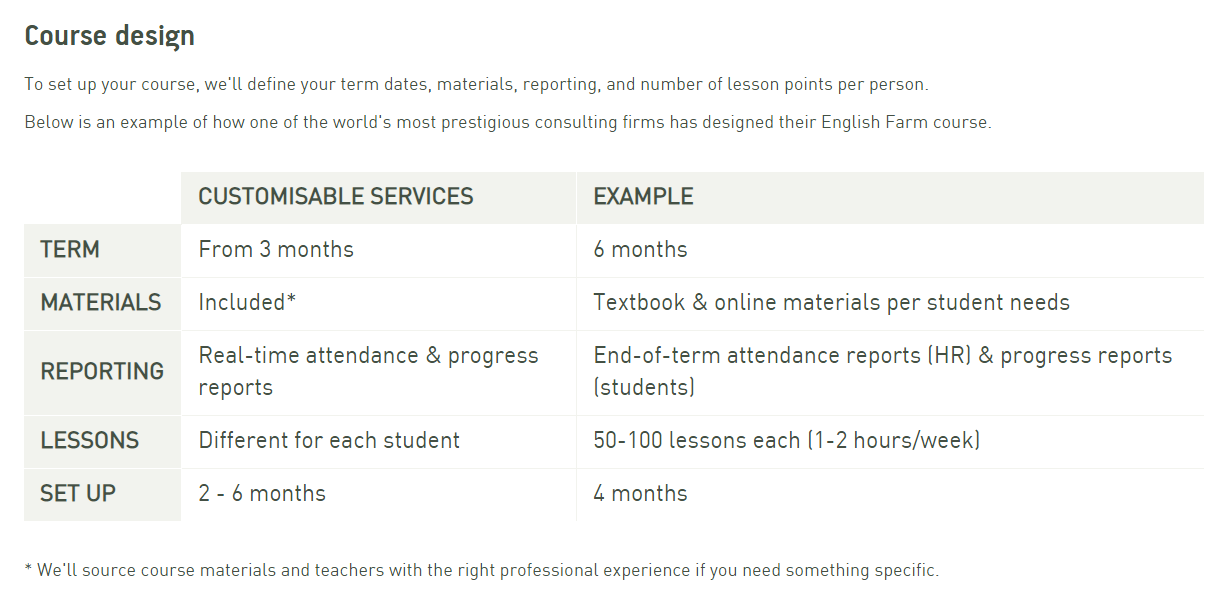
Note: Set up time on TEF's side is literally a couple of hours. We just need to create a company profile page, term points and then enroll students by uploading a spreadsheet. However, due to internal processes on the client side, getting a programme started can take some months (for approval, budgeting, vetting of the services contract etc). The set up time above includes running the pilot programme and initial client meetings.
Prices
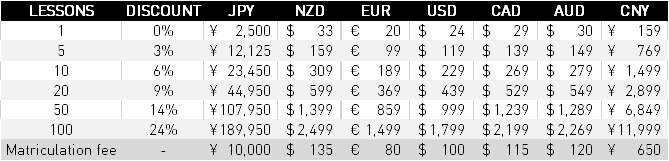
These are our retail prices in the suite of currencies we accept (as of May 2020). They are negotiable depending on volume.
Discounts
The default corporate discount is as follows:
| Points | Discount |
|---|---|
| 1 | 0% |
| 10 | 0.4% |
| 20 | 0.8% |
| 50 | 2% |
| 100 | 4% |
You can negotiate up to the constraints below.
Corporate discount limits:
- Standard corporate discount: ~4%
- Corporate discount limit: 8% You can give up to 8% off without approval from Spiros or Matthew.
- Matriculation fee discount: Can be discounted pro-rata if a term is shorted than 6 months (e.g. 50% off for a 3 month term) to a maximum of 50% (this covers course costs).
Notes:
- Offer discounts on matriculation fees first and go steeper there to show flexibility.
- Note that taking a "the price is the price" approach has worked in the past. Only IHI negotiated on price (and not at all aggressively).
- Matriculation fee includes materials. If a client opts to have students buy their own textbooks, then matriculation fee can be halved.
Can we discount further?
Maybe. Most English teaching schools use only 20 - 25% of their revenue to pay their teachers. We believe in taking care of our teachers so they will take care of our students. This is why up to 80% of TEF's revenue goes directly into teachers' wages (we flip the traditional cost structure on its head). The rest goes into operations and improving our systems for HR, students, and teachers.
You get what you pay for, and we provide excellent service (quality teachers, support staff, decreased admin load for HR) and services (e.g. homework, audio recordings, skills/progress assessments, etc.).
However, if we are talking large numbers, then there is room to move. It will require discussion with Spiros & Matthew.
The matriculation fee
Includes:
- 1 or 2 free textbooks per term (depending on whether or not a student changes their course midterm)
- reporting (HR can look on our HR portal of our website and see who is taking lessons, who isn't, and who is constantly late. They can check in every month if they'd like. They can check the TEFscore (coming));
- full customer support (responding to student questions, reminding students to take lessons, following up on textbook orders, etc.);
- integration set-up costs; and
- ongoing customization.
Packages
Each student enrolled must nominate the number of lessons they wish to take in the term. HR can constrain this (e.g. BCG says 50 or 100 lessons per term). Our system is totally customisable in this respect (see onboarding & enrollment).
Payment terms
Invoices are sent in the first week of the month. Payment is due by the end of the month following receipt of an invoice.