
Take a closer look.
Based on 15 years of coaching and data from thousands of test-takers.
I have been teaching consultants for the G.B.C. test since 2011 (from when it was called the FSI Test). I have learned a few things that I would like to share with you to help you better prepare for your test in 2026.
Note: None of this is official information. The English Farm has no official connection to the G.B.C. test. This is information gathered from research and talking to more than 130 different people who have taken the test.
The Nature of the Test
The G.B.C. is mysterious—English teachers and students alike are often unaware of it, and internet information is scarce.
- Administration: It is administered by Berlitz in Japan (the test was formerly known as the F.S.I.).
- Format: It is a 20-minute interview. You are asked questions by an interviewer, and the session is recorded.
- Grading: The recording is graded out of 5. It takes 2 to 3 weeks to get your score.
- Structure: Questions start simple and get harder and harder. They are designed to be "too difficult" to put you under pressure so the tester can see how you perform in that situation.
- Pedigree: It is based on a scoring system used by the American government for the CIA, FBI, and NSA (essentially: Are your language skills good enough to be a spy?).
Understanding Your Score
- Scores based on Frequency: Each score (1 - 5) reflects the frequency of errors—usually the higher the score, the better. Your teacher can help you identify areas in which you can make the most rapid progress. To score well, you don't need to be perfect.
- Weighted Averages: The average scores often don't seem to make sense mathematically; they are likely a weighted average (check your results to see).
- Fair but Subjective: It is very fair in the sense that you cannot "fake" it—it is a true assessment of your English level. However, it is subjective; because it is a speaking test, you may perform well one day and badly the next.
- Strict Standards: Scoring is very strict. Most people in English schools in Japan score between 1.5 and 2.5. Almost all people who score above 2.5 have spent significant time living or studying overseas.
- The 1.8 Ceiling: Japanese people who have never lived overseas almost never get more than 1.8 for pronunciation.
Realistic Expectations for Improvement
Many people approach the test wrongly, thinking a 900 TOEIC or 3 months in Canada will make it easy. This is wrong. Unless you lived in the States for years and earned a university degree, you will probably get a shock.
- The Pace of Progress: If you are working full-time and studying your hardest, the fastest you can improve your score is by 0.1 every six months.
- The First-Timer Exception: People who know nothing about the test tend to do very badly the first time because it isn't like Eiken or TOEFL. On their second try, their score may jump more than 0.1, but they then return to the maximum pace of 0.1 per six months.
- Fluctuation: Improvement is not constant; it will speed up and slow down. You cannot improve by much if you only practice for the test—for long-run improvement you must simply get better at English.
Case Study: A "Good Student" Example
I have taught a Japanese student since 2012 who works crazy hours (morning until midnight plus weekends) in a stressful business. Despite this, he studies two lessons a week and always prepares.
His progression shows:
- First attempt: Very low (he didn't understand the test).
- Second attempt: Jumped by 0.2 points after preparation and strategy work.
- Long-term: His average improvement is 0.06 every six months.
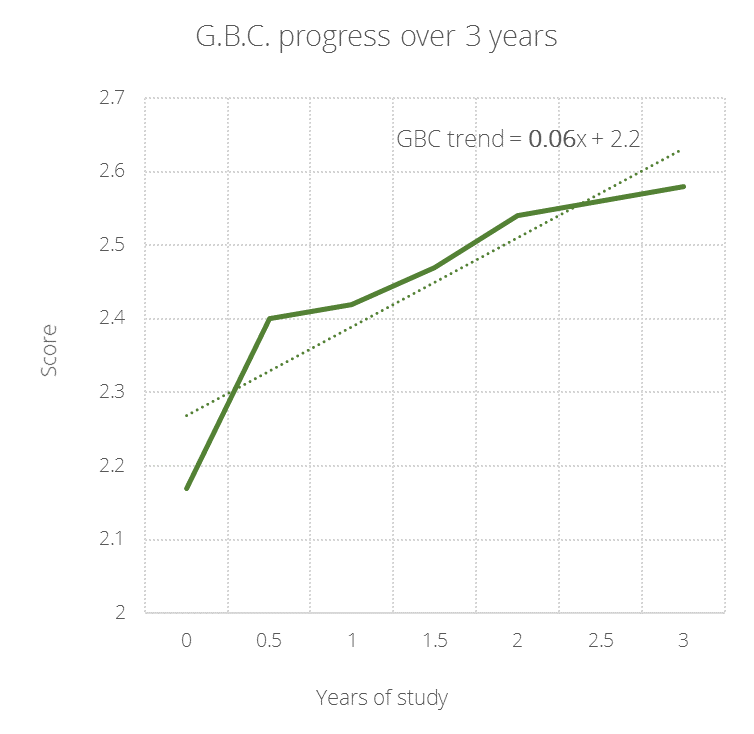
Forecast: For this "good student" to reach his goal of 3.0, it will take another 2.5 to 3 years of hard study:
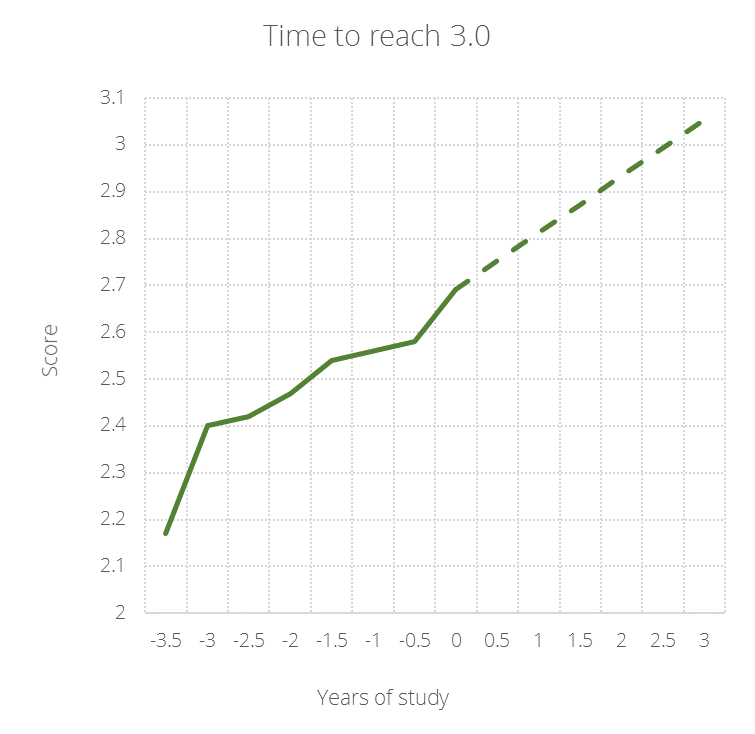
Your Professional Goals
If your company uses this test, you are likely in a high-level professional, diplomatic or consulting role with a successful career ahead. However, your company's target is probably far too low.
- The Professional Reality: If your company says 2.X is enough to talk to a foreign client, imagine if I had that same level in Japanese—would you let me talk to your clients? No way.
- The Risks of < 3.0: You may frustrate colleagues, be inefficient, or even appear accidentally rude.
- The Target: If your goal is to work internationally, you should aim for a minimum of 3.0. If you are at a 2.0 now, it may take 5 years of hard work, but you will become an "unstoppable international business machine."
The English Farm has prepared thousands of people for the GBC test over more than 10 years. We can help you to achieve the score you need with one of our GBC courses—learn about the structure of the test, the best strategies for success and practice using our database of more than 2,300 past GBC questions.
Buy a lesson package to get started. If you are not sure, reserve a free 15-minute chat about your needs with one of our learning advisors.
Your teacher at the English Farm can help you focus on improving those areas in which you scored the lowest in your previous tests, as well as selecting a course for your individual needs to improve your English capability.